
.png)


.jpeg)
Every CHRO I talk to is wrestling with some version of the same problem. Their enterprises are making significant bets on AI — for productivity, for development, for talent — but the frameworks for measuring the impact on their people and forecasting the longer-term implications haven't kept pace. When technology moves faster than organizational wisdom, transformation gets done to a workforce rather than for it.
Today, we're launching the Valence Research Initiative, a project dedicated to producing rigorous research on how AI is actually reshaping human performance at work, grounded in data from real AI use at large enterprises. Our mandate is to map the terrain: to bring evidence from inside real enterprises, name what's already common ground versus what's still genuinely contested, and give HR leaders the frameworks they need to make confident, evidence-backed decisions. Our research is guided by a single question we believe will define the next decade of work:
What will make people great at work in the age of AI?
I'm even more excited to share that Prasad Setty will serve as the Chair of the Valence Research Initiative. As the founding Vice President of People Analytics at Google, Prasad built and led the function that set the standard for how the world studies human performance at work — his team's Project Oxygen proved great managers are made, not born, and Project Aristotle established psychological safety as the defining variable in team effectiveness, together reshaping how organizations think about management, team design, and performance measurement.
"For most of my career, the central question in people analytics has been: what actually makes people effective at work? AI is rewriting that question in real time, and the Valence Research Initiative presents the chance to study real deployments, with real workforces, in partnership with the leaders accountable for the results. That is the work I want to spend the next decade on." — Prasad Setty, Chair, Valence Research Initiative
Valence is a natural home for Prasad’s next chapter of his research: since launching Nadia in early 2023, we've partnered with hundreds of visionary HR leaders at the world's largest companies to bring AI coaching to their workers, and Nadia is now used across more than 100 enterprise deployments with over two million coaching conversations. The Valence Research Initiative will pair Prasad's research rigor with that scale of real-world enterprise AI deployment data.
Valence Research Initiative chair Prasad Setty and Valence founder Parker Mitchell on why the initiative exists and what insights have come from the initial research into AI coaching and performance
Three Areas of Contested Terrain
We're starting where the terrain is most contested, with three questions:
1 — How is the nature of work itself changing?
AI is changing the substance of work, not merely its speed. AI can both automate the transactional parts and it can amplify the parts that differentiate people.
While we’ll look at both sides, we’re most interested in the latter. What becomes possible when AI sharpens what makes people distinctive, rather than only clearing away the work that doesn't?
2 — How does the coordination of work need to change?
Once the work changes, the way we organize it has to change too. We'll study how teams and functions form, dissolve, and get redesigned as old assumptions stop holding, and what HR becomes as the function that has historically owned those decisions.
Because the future is often discovered at the edges, we'll also bring in perspectives from companies making riskier bets, and we'll stay honest about where there's real agreement and where the field is still guessing.
3 — How will we learn, grow, and thrive?
As AI becomes present and proactive in the day-to-day, the bar moves from whether people adopt it, to how fluent they become and then to how they use it to learn, grow, and hold real agency over work.
We'll test whether AI can build the skills traditional development has struggled to move, especially the soft and collaborative skills, and what early evidence from Valence's work inside enterprises shows about what changes when people work alongside AI consistently.
Our Emerging Findings: The Link Between AI Coaching and Performance
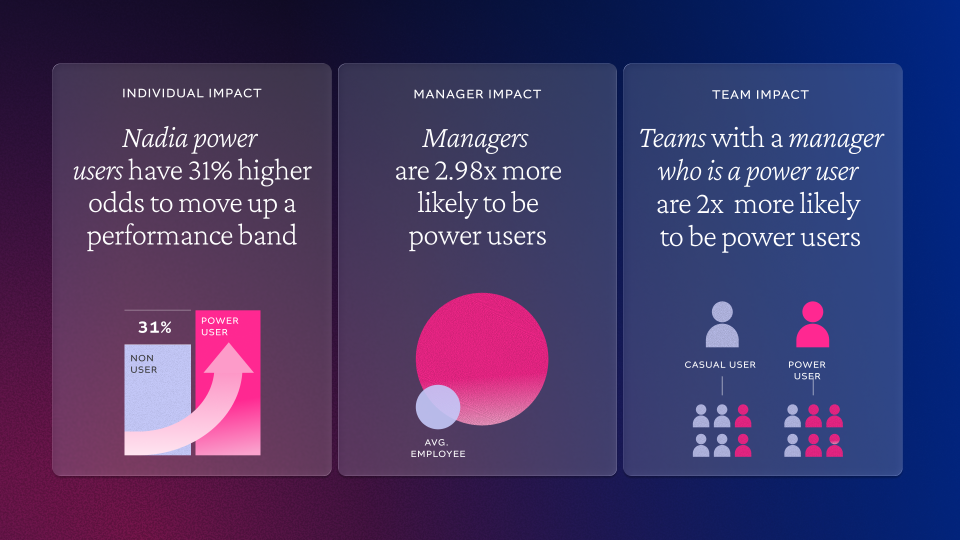
In our first research project, we analyzed 64,000+ coaching sessions and 11,000+ employees over 15 months to compare how employees moved across performance bands before and after Nadia was introduced, and how that movement correlated to how they used Nadia, not just if they logged in.
Power users, the employees who engaged with Nadia consistently, broadly, and deeply, had 31% higher odds of advancing a performance band than others. When managers were power users of Nadia, their teams were 2x more likely to be power users too, a signal that manager behavior could be a powerful lever for AI rollout at scale.
Note: Our research draws only on aggregate, anonymized usage signals and patterns, never the content of individual coaching conversations
An Invitation to our Clients and Community
The Valence Research Initiative will be built in partnership with the enterprises we work with, our advisors, and our broader ecosystem of partners.
We're actively looking for leaders and organizations to collaborate with us on the questions that matter most to your HR agenda. If you're a CHRO or HR leader thinking about how to measure the impact of AI at your organization, and what it will take to get adoption right, we'd love to hear from you.
Learn more
— Parker Mitchell,
CEO and Co-Founder, Valence
Lorem ipsum dolor sit amet, consectetur adipiscing elit. Suspendisse varius enim in eros elementum tristique. Duis cursus, mi quis viverra ornare, eros dolor interdum nulla, ut commodo diam libero vitae erat. Aenean faucibus nibh et justo cursus id rutrum lorem imperdiet. Nunc ut sem vitae risus tristique posuere.
Lorem ipsum dolor sit amet, consectetur adipiscing elit. Suspendisse varius enim in eros elementum tristique. Duis cursus, mi quis viverra ornare, eros dolor interdum nulla, ut commodo diam libero vitae erat. Aenean faucibus nibh et justo cursus id rutrum lorem imperdiet. Nunc ut sem vitae risus tristique posuere.
Lorem ipsum dolor sit amet, consectetur adipiscing elit. Suspendisse 2 varius enim in eros elementum tristique. Duis cursus, mi quis viverra ornare, eros dolor interdum nulla, ut commodo diam libero vitae erat. Aenean faucibus nibh et justo cursus id rutrum lorem imperdiet. Nunc ut sem vitae risus tristique posuere.
Lorem ipsum dolor sit amet, consectetur adipiscing elit. Suspendisse 3 varius enim in eros elementum tristique. Duis cursus, mi quis viverra ornare, eros dolor interdum nulla, ut commodo diam libero vitae erat. Aenean faucibus nibh et justo cursus id rutrum lorem imperdiet. Nunc ut sem vitae risus tristique posuere.
.png)
